
Author: Elisa Mazzilli
Committee: Art & Cultural Heritage Crimes Committee
Date: 17/11/2026
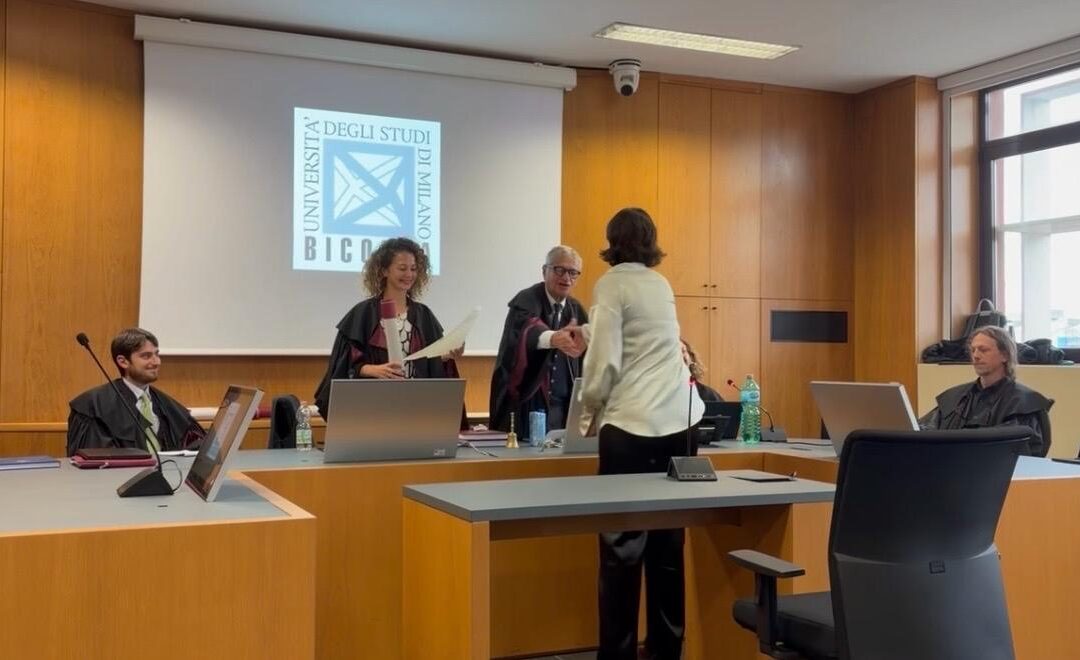
| On 21 October 2026, during the second graduation session of the 2025/2026 academic year, Elisa Mazzilli presented her Master’s thesis entitled “Protecting Intangible Cultural Heritage in Europe: Criminal Law Responses and the | |
| Emerging Role of the EPPO.” | |
The inspiration for this research stems from Elisa’s active participation in the various activities promoted by the Art and Cultural Heritage Crimes Committee, which have enabled her to develop a strong interest in the analysis of cultural heritage crimes, the role of the European Union in addressing these offences and, more specifically, the work carried out by the EPPO.
The activities organized by the Centre of Excellence also enabled Elisa to establish contact with several scholars who are experts in the field, including Dr Adina Hulubas, Dr Andrzej Jakubowski, and Professor Lucas Lixinski of the Department of “Law and Justice” at the University of New South Wales (Sydney). These connections, facilitated by Professor Ubertazzi’s support and encouragement, allowed Elisa to develop a highly practice-oriented thesis, incorporating several discussions and interviews with these leading experts in the field.
The thesis was written in Sydney as part of the “Exchange Extra-EU” programme promoted by the University of Milano-Bicocca. Professor Lucas Lixinski served as co-supervisor of the thesis. His expertise in cultural heritage law and policy, with a particular focus on UNESCO policies, proved essential to the development of a thesis that not only offers an in-depth examination of European law but also places strong emphasis on the international context, particularly UNESCO’s policies.
Thanks to Professor Lixinski’s invaluable supervision, alongside the contributions of the other academics involved, the thesis sought to address an interesting research question: How can the EPPO, as an authority tasked with protecting the EU’s financial interests, contribute to the safeguarding of Intangible Cultural Heritage (ICH)?
To answer this research question, four key aspects were addressed during the thesis speech:
1. Why is it important to address the safeguarding of ICH in the European context?
2. What role does criminal justice play in this field, and what are its limitations when it comes to protecting ICH?
3. What contribution can the allocation of EU funds and economic incentives make to this process?
4. How does the EPPO therefore become an important guardian of the safeguarding of ICH?
When discussing the protection of ICH, it is important not to consider it merely as a collection of cultural practices, values and expressions. At the European level, ICH also plays a fundamental role in achieving broader objectives. For instance, it is recognised as a “unique resource” that plays an important role at the environmental, social and economical levels. It is also considered a strategic resource for promoting sustainable tourism and fostering a shared European identity. An important resolution adopted by the Council of Europe, Resolution 2269/2019, entitled “Safeguarding and Enhancing Intangible Cultural Heritage in Europe”, explicitly recognises ICH as a driver of economic, social and territorial cohesion, making it an important tool for supporting the European integration process. European integration is recognised as one of the founding principles of the Union, alongside the other fundamental values enshrined in Article 2 TEU. Recognising the close interdependence between these values and the role played by ICH means acknowledging ICH as one of the key instruments through which European values can be promoted and upheld, thereby contributing to the integrity of the European project as a whole.
In this regard, the thesis examines the role of the various instruments developed over time to safeguard ICH, including the role played by criminal justice. The main conclusion reached by this research is that traditional criminal justice mechanisms can contribute to the safeguarding of ICH only indirectly. Criminal justice has been one of the European Union’s major areas of interest since the entry into force of the Maastricht Treaty. The combined application of Articles 83 and 167 TFEU has, over time, contributed to the recognition of crimes against cultural property as a serious form of international crime. Nevertheless, most European legal instruments addressing this issue, starting with the 1995 Europol Convention, Directive 2014/60/EU and the 2015 EU Action Plan against Trafficking in Cultural Goods, focus specifically on cultural goods and, therefore, on the tangible aspects of cultural heritage, without explicitly addressing ICH. The absence of a specific legal framework criminalising acts committed against ICH stems primarily from the fact that most forms of harm affecting ICH do not result from deliberate criminal conduct, but rather from more complex social and geopolitical challenges. These include massive tourism, population ageing, industrialisation and migration. Such circumstances make it difficult to apply traditional principles and concepts of criminal law, particularly criminal liability and the principle of legality, as enshrined in Article 49 CFREU and Article 7 of the ECHR. The conclusion that criminal justice provides only indirect protection to ICH is further supported by Professor Lixinski. He was a member of an expert group established by UNESCO pursuant to Decision 19.COM 13. Taking into account the “deep-seated interdependence between tangible and intangible cultural heritage” as recognised in the preamble to the 2003 UNESCO Convention for the Safeguarding of the Intangible Cultural Heritage, the group concluded that any attack on the tangible components of cultural heritage may also constitute an indirect, yet significant, attack on the values and practices associated with them.
Furthermore, the specific concept of “safeguarding” developed under the 2003 UNESCO Convention aims primarily to ensure the viability of this form of heritage, rather than to impose rigid forms of protection. This understanding is also shared by the European Union. Resolution 2269/2019 states that European policies should support the development and free evolution of ICH, rather than seek to protect it rigidly. In this respect, the allocation of cultural funds and economic incentives represents one of the most effective ways to promote awareness and understanding of the cultural practices and expressions associated with ICH, ensuring that they can continue to evolve over time.
These conclusions are supported by Dr Adina Hulubas and Dr Andrzej Jakubowski. Dr Hulubas, in particular, emphasises how cultural funding directly contributes to increasing knowledge and awareness of the cultural practices and expressions associated with ICH. Dr Jakubowski, on the other hand, highlights how the allocation of funds and economic incentives is essential to creating an enabling environment in which ICH can continue to be preserved, practised and transmitted.
This final conclusion makes it possible to examine the role played by the EPPO in the safeguarding of ICH. As we know, the EPPO is not a cultural heritage authority, and its mandate, as established under Article 86 TFEU, the PIF Directive and Regulation (EU) 2017/1939, is strictly confined to the protection of the financial interests of the European Union. Even when considering a possible extension of its competences pursuant to Article 86(4) TFEU, some degree of regulatory harmonisation concerning offences involving the ICH sector would be necessary. However, as discussed with Professor Lixinski, “the absence of a comprehensive body of law governing the protection of ICH”, combined with the significant role played by the principle of subsidiarity, makes it difficult to achieve a sufficient degree of harmonisation at the EU level. This, in turn, prevents the EPPO from relying on a specific and comprehensive legal framework dedicated to ICH. Nevertheless, the EPPO’s mandate is not sector-specific; rather, it depends on the nature of the offences committed. In this context, crimes affecting the cultural heritage sector may encompass a wide range of criminal conduct, including money laundering, tax evasion and fraud. Such offences may undoubtedly fall within the EPPO’s remit. In practice, several recent EPPO cases have involved the cultural sector, particularly its tangible dimension. Examples include the restoration of the Petrich Museum in Bulgaria in 2025 and Operation Yellow Brick Road, concerning the restoration of Sofia’s historic city centre in 2023. In both cases, the central argument of this thesis remains relevant: protecting the tangible components of cultural heritage can also contribute to the indirect, yet significant, safeguarding of the intangible values, meanings and practices associated with them. Through the exercise of its mandate, the EPPO can therefore help ensure the proper implementation of policies aimed at protecting cultural heritage, particularly where the misuse of EU funds or other offences affecting the Union’s financial interests are involved. This contributes to creating the conditions necessary for ICH to continue to be practised, preserved and transmitted across generations.
Conclusions:
The thesis was specifically aimed at identifying common ground between the EPPO’s mandate and the safeguarding of ICH. Through the researches of this thesis it was possible to develop an original perspective on how the EPPO can indirectly contribute to the safeguarding of ICH. As highlighted, safeguarding ICH does not fall within the EPPO’s mandate. The Office although plays a complementary role by protecting the EU’s financial interests and ensuring that EU funds allocated to the cultural sector are not undermined by fraud or other criminal activities falling within its competence. In doing so, the EPPO helps preserve the financial conditions necessary for cultural policies and programs to be implemented effectively. Its contribution is therefore not to safeguard cultural expressions and practice directly, but to protect the financial resources that enable the initiatives, institutions and also communities that are responsible for their preservation, development and also transmission.
In this regard, Professor Lixinski argues that the best way to safeguard ICH is to “create a bubble” around it, thereby allowing ICH to continue to evolve, be practised and be transmitted from one generation to the next. The EPPO’s action contributes precisely to this objective. By protecting the financial resources and EU funds allocated to the cultural sector, the EPPO helps create an environment in which cultural policies can be effectively implemented, thus ensuring the viability of the practices, expressions and values that constitute ICH. In this way, the researches conducted bring to light an important and often overlooked link between the protection of the EU’s financial interests and the safeguarding of ICH.